
Trotters children’s clothing retailer chooses Eurostop for its stores and website
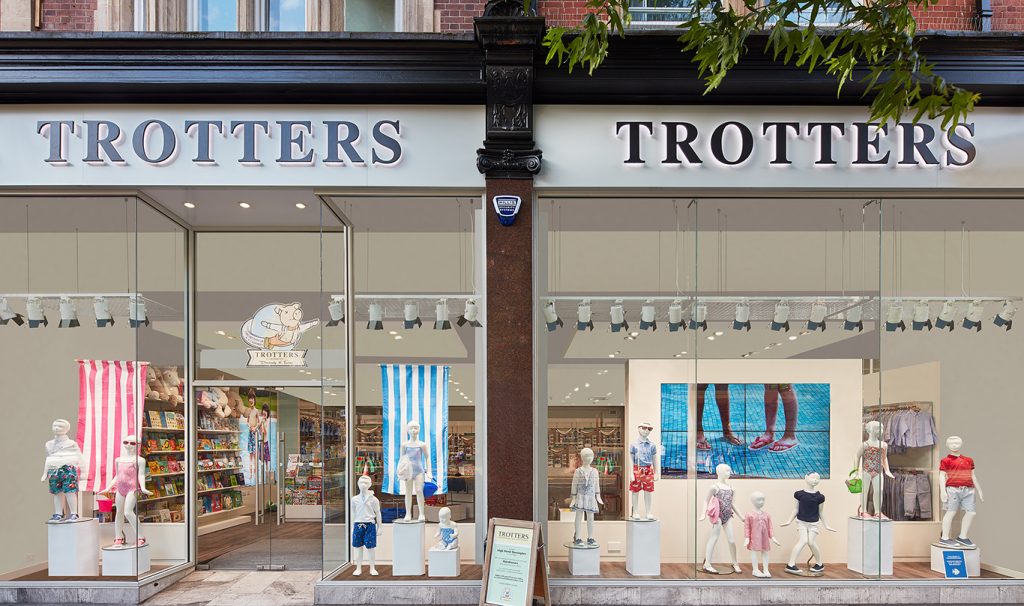
High quality children’s fashion stores favoured by many famous clients, chooses Eurostop’s connected EPOS and retail systems to manage business Eurostop has announced that Trotters, the independent children’s clothing retailer has chosen Eurostop’s connected EPOS and retail solution for its stores, head office and website. The family-run business currently has six outlets – across London as well as one in Guildford – and its successful online store. Trotters has selected e-pos touch, EPOS estate manager, e-rmis and e-cubes to manage stock across all channels, enabling it to provide its unique customer experience and clothing for which it is renowned. Trotters caters exclusively for children from 0 -11 years, offering clothes, shoes, books and toys – its flagship store in London’s Chelsea even hosts a hairdressing department with a giant fish tank. Trotters attracts many famous clients, from all over the world. Trotters has selected Eurostop’s EPOS, e-pos touch connected to its e-rmis head office system to capture sales at till-point. Eurostop’s EPOS software has an intuitive touch screen display that is easy to use and complements the stores’ modern designed interiors. Eurostop’s EPOS estate manager, connected to e-rmis will enable Trotters to manage stock across all of its stores and warehouse as well as fulfil all online orders seamlessly. The additional e-cubes module will provide enhanced business intelligence reporting functionality – by providing Merchandising, EPOS, Warehouse, CRM cubes which will allow users to compile their own bespoke report for more efficient stock management. Deborah Loh, Marketing Manager at Eurostop, said; “We are delighted to be working with the childrenswear retailer. Trotters has successfully built their business by providing quality merchandise and the best possible customer experience. Eurostop’s seamless and versatile omnichannel retail solution has e-rmis at its core and has been designed to support retailers like Trotters to manage their whole business. It provides up to the minute stock information from one application, even with multiple locations and cross channel, enabling them to respond quickly to the business needs and meet customer demand.”
Festive fun at Eurostop

With the festive season upon us, we decided to have a little fun with our Secret Santa and Christmas Jumper Day 2017! There were some very bright outfits that raised a smile, unfortunately the photos don’t quite seem to do the array of flashing LEDs justice! Judging the competition was our special guest Mark Tiling from Leventis Overseas. Thank you Mark for joining us, and congratulations to Roy Meunier, who won the Eurostop Christmas Jumper Day competition 2017! Eurostop takes a festive break on the 25th December, and reopens again on the 26th. We wish all of our customers and partners warm wishes for the festive season and look forward to working with you all in 2018.
Celebrating three milestone anniversaries

Last month, we marked three special dates. Sab Sothinathan and Kumar Ramanthan started with the company 20 years ago and Sanjay Pote celebrates his 10 year anniversary with Eurostop in 2017. We want to congratulate all three of them on their special milestones and most of all thank them for all their hard work. They join what is fondly known as the ’10 and 20 year clubs’ at Eurostop. Sab Sothinathan, who started as a Clipper programmer, has built up a wealth of experience over his career and now uses his expertise to provide application support in the specialised area of ticket printing, said I have had many challenging but rewarding experiences throughout the past 20 years at Eurostop Richard Loh commented It’s great to have such long serving members of staff. They have been with me since near the start, and it’s really nice to see their personal growth, along with that of the business. I would like to thank each of them for their dedication and support. Congratulations Sab, Kumar and Sanjay!
Is Bricks and Mortar in Terminal Decline?
Recently I read this blog about how bricks and mortar retail is in decline. There are some persuasive statistics to back up the byline, but personally I can’t help but feel excited about the potential of what is to come in physical retail spaces, if only retailers can get it right. Digital disruption need not spell the end for bricks and mortar stores. Instead focusing on changing consumer expectation, behavior and needs for a new generation could re-imagine a whole new retail environment, where digital needs to be embraced. ‘Omnichannel ‘ is the buzzword of today, but surely the utopia is where there are no longer perceived ‘channels’ but the physical and digital merge so that all retail touchpoints are one of many on–demand interactions with the brand? The Professor professes to a lack of customer service in traditional stores, and I have to say that as a consumer I do often find this to be true, but why not use digital technology to assist and differentiate, rather than shut them down? why not use digital technology to assist and differentiate, rather than shut them down? As Millennials, also known as Digital Natives or Generation Me, enter their prime spending years,it seems clear that they will drive a ‘Customer centric’ approach to products and services. Surprisingly, the physical store continues to be important in their journey to purchase, they just expect more out of the experience. Retailers need to get to know their new friends, who are described amongst other things, as tech-savvy, impatient, demanding and social. By adapting the in-store experience to suit the wants and needs of the new generation, those retailers will make sure that they stand tall above the rest. The physical store continues to be important in their journey to purchase, they just expect more out of the experience. On the high street there are stories of retailers succumbing to current pressures, but turn right, and you will see shining examples of those who are evolving and changing the status quo with a new level of technology and services. Online retail certainly has choice, convenience and value for money on its side, but shouldn’t retailers build on the unique value proposition of the high street as part of its offering? Better in store customer experiences I stand in awe at the retail giant that is Apple. Their minimalist stores are always packed, and yet upon purchase of one of their items in store, I come away impressed with the service and thought that they have put into the ‘Apple experience’. As I browse and test out the latest devices that are conveniently Wifi connected (I can indeed participate in the worrying trend of ‘showrooming’, or simply check out some online reviews), I can’t help but notice another customer, who has been bought an Apple Watch by her husband as a birthday present. She is not rushed to complete the transaction (by mobile payment, while seated at a bench), but is then offered help in setting up her new purchase. Surely this goes against the grain of serving more customers in less time? I imagine that she will return home excited and show her newly ‘connected’ watch and experience with her friends – the best type of brand ambassador. Embrace the physical space The pure play etailer Missguided has recently opened 2 new stores in the UK. The visual experience in store doesn’t disappoint and is a 3-D extension of their brand persona, brought to life in the physical realm. No longer is a shop just a shop, but an inspiring and entertaining place to be, and you want to go back for more – pop culture language is inherent in all the décor, and talk of unicorns just takes you to a fun place where you might hang out with friends – which they hope you will be. The constant and live stream of fashion inspiration on the immersive digital displays brings the digital and physical world together. It seems like the investment in store design paid off. This online success story now has a place you can visit, why wouldn’t you want to hang out and share on social media? Get to know them There are many other examples of brands that are building relationships with us. In an age where we are no longer limited by geographical boundaries, consumers have endless choice and information at the touch of a screen. Retailers really need to be on the ball in nurturing personalized and engaging relationships with their brand. With a wealth of digital analytics and data available, by implementing the right tools and technology, retailers can get insights into the preferences of their customers and adjust their marketing and promotions accordingly. For example notifying customers of offers that they are likely to be interested in, based on past shopping history. These promotions have to be seamless across physical and digital ‘boundaries’, because the consumer of today expects nothing less. Understand your customers, not only how they like to shop, but their lifestyles and the communities that they live their lives in. Convenience is key and retailers need to determine the preferences of their demographic. For example, if their customer base has a large mobile following who engages on social, they need to make sure that they have a slick mobile app with built in social sharing to the right platforms. Understand your customers, not only how they like to shop, but their lifestyles and the communities that they live their lives in. Right here, right now Millennials have grown up with smart phones. This hyper connected generation always has their devices on hand – accustomed to getting what they want, when they want. This urgency also applies to expectations for services in store. This hyper connected generation always has their devices on hand – accustomed to getting what they want, when they want. Certainly from a personal point of view, I have walked back out of a store, if I see that there
We’re delighted to announce the launch of our new redesigned website

November sees the launch of our new Eurostop website, with a totally new look, content and navigation. Importantly in a digital age, our website continues to be mobile friendly, for easy access on demand. Please take a look around What is new? – well, we have listened to your feedback and made some changes to the navigation so that it’s easier to find your way around. We have also refreshed the content and are using less words, but trying to get straight to the point about how using our retail systems really can benefit your business. Look around Let us know what you think We know you are busy, but if you have 3 minutes, we would love to know what you think and if there is anything that we can do anything better. Website Feedback Survey
5 reasons to consider a mobile first e-commerce website

As a consumer, we are constantly enticed to purchase the next ‘must have’ item. We are presented with new and exciting ways to shop or are reminded to take advantage of that bargain promotion just received via email. In this digital age, the ways in which to browse and complete that purchase become more and more slick. A competive market offers us options and why wouldn’t we go for the retailer that offers a more sophisticated customer experience? After all, with the ever widening internet there is a whole range of possibilities. But what is going to convince your customers to be loyal to you? What is going to help entice new customers to see what you have to offer? With consumers expecting more sophisticated interfaces and retailers trying to develop more personalised experiences, if you are to remain a player in this competitive arena where customer loyalty is key, two important concepts are omnichannel and mobile. Eurostop takes a look at some of the key reasons why if you haven’t already done so, you need to look at your online mobile experience – in fact why you need to make it mobile first. 1. Omnichannel is the new buzzword. Mobile is an essential part of the omnichannel/cross channel/connected customer experience. Argos reported that in 2014, 44% of sales started online, although 90% of transactions involve a store. The lines between online and shopping in store are blurred. Consumers expect to be able to browse, research, purchase, return and choose delivery options wherever they are and on the device they have to hand – whatever is more convenient, they are in control. Mobile is even often part of the instore experience. As customers pick up an item in store, they are swiping their mobile device to check if they can get a better deal online or in another store. As a retailer, you need to ensure that you provide an interface that encourages them to remain loyal, or encourage them to look at other upsells. Do this by providing a content rich website that is mobile friendly. 2. Become mobile friendly or lose out. Statista, an online stat service predict that In 2017, figures suggest that more than 90 percent of internet users will access online content through their phones. The statistic speaks for itself. 3. Becoming mobile first forces you to focus on what’s important. The principle of mobile first means that you take a practical approach to design. With limitations on screen real esate, only elements vital for the user experience are included. Adding more only as screen space increases means screen bloat is reduced when optimisation is essential. 4. Browser or app? If budget is a consideration, then the most cost effective solution is a mobile first website. The solution is optimised for mobile, meaning that not only is it smart phone compatible, but it will adjust layout to scale up for tablets and desktops. One website to maintain. One site fits all devices and browsers. 5. Google’s mobile ranking. In April, the giant made changes to the way in which they rank results on mobile devices. Considering point number 2, you want to make sure that your website is returned nearer the top of the list in a search. If you want to check if your pages are mobile friendly, use Mobile Usability report in Google search console (Webmaster Tools) So the question ‘can I afford investing in mobile commerce?’ has really got to be ‘can I afford not to?’ Eurostop offers a connected ecommerce solution that maintains open communication with your other channels – both head office and the bricks and mortar stores. There are no clunky interfaces to maintain or dual management of your product, stock inventory and customer loyalty information. The responsive mobile first user interface ensures that it is mobile optimised and the easy to use content management system provides you the control in keeping your website up to date.